- Winnipeg State of Mind
- Posts
- 2025 Reading Recap
2025 Reading Recap
I hit a new personal best in number of books read this year

Nigel Webber
January 02, 2026
2025 was a good year for reading. I read some amazing books, and got to a new record of books read in a year with 45 (beating last year’s 41). I read almost exclusively nonfiction, with “The Lord of the Flies” being the only fiction book I read; I’m fascinated by history, true crime, and narrative nonfiction books. If there was a theme to my reading this year it would definitely be books that later became movies/TV series, with nine of the books I read later becoming developed for the screen.
The Numbers:
45 - Total number of books finished
23 - Books from the Winnipeg Public Library
3 - Books by Garrett Graff
2 - Books by T.J. English
2 - Books by Hampton Sides
Apart from Graff, English, and Sides, I had no other repeat authors this year, with a lot of new authors for me. In no particular order, here are my ten favourite books of the year (full list at the end).

I finished another book after Goodreads sent me this graphic, so it should be 45 books.
A Flower Travelled in my Blood - Haley Cohen Gilliand
This was absolutely the best book I read this year, hands down. I had found out about it earlier in the year through a post by David Grann (of “Killers of the Flower Moon” fame) and eagerly anticipated its release this past summer, and it did not disappoint. The book tells the devastating story of the Abuelas de Plaza de Mayo, a group of Argentinian grandmothers whose children were ‘disappeared’ by the dictatorship in the 1970s and ‘80s either along with their young children or while pregnant, then forced to give birth in captivity and relinquish the child. Heartbroken over the loss of their children, the abuelas refuse to give in to the dictatorship, instead fighting for decades (and still to this day) to reunite with their lost grandchildren, most of whom were adopted by complicit military officers. The story is absolutely heartbreaking, but still filled with so much hope as slowly the grandmothers and grandchildren are reunited. Written beautifully by Gilliand, this book has deservedly been acknowledged on many year end lists as one of the best nonfiction books of the year.
The Only Plane in the Sky - Garrett Graff
I read three Graff books last year and three this year, as well as subscribing to his newsletter and listening to a season of his podcast, so undoubtedly I’m a fan of his work. But this book will stay with me for a long time. An oral history of September 11, 2001, “The Only Plane in the Sky” leaves aside all of the political attachments there are with that day and instead focuses on the human side, literally telling the story through the voices of hundreds of people affected by the tragedy that slowly unfolded. As someone who has also written an oral history, I can’t imagine how much effort went into assembling all these people’s stories into such a cohesive narrative, but Graff is a master.

The Wide, Wide Sea - Hampton Sides
There is a small cadre of elite narrative nonfiction authors active today, and Hampton Sides is right there at the top. His latest effort (released in late 2024), is about the final voyage of Captain James Cook in the 1770s. Impeccably researched, this history is so fascinating to me, because even though Cook was a deplorable individual, his explorations helped set in motion the catastrophic colonization of many Indigenous communities all around the Pacific and this book is a step to understanding that history. Many fascinating historical tidbits exist here, though, including that it was on this voyage that the first written descriptions of surfing, tattoos, and of many extinct animal and bird species; as well as the fact that one of Cook’s officers was a man named George Vancouver, who first passed what is now British Columbia and resolved to return, eventually becoming the city’s namesake. The most brilliant part of the book, however, is that it does not condone any of the voyage’s colonial actions, and in many cases draws on Indigenous oral history accounts to provide their perspective of these first contact encounters.
The Power Broker - Robert Caro
I feel as though I’ve been burying the lede a bit when it comes to the books I read this year, because I tackled the tome of all tomes, “The Power Broker.” Read in two parts, this 1,200 page book, about New York City parks commissioner Robert Moses, took a combined six weeks to read, and it was worth every paragraph. Meticulously researched, Caro is the gold standard for nonfiction writing, and has been ever since this book originally came out in 1974. Although often incredibly dense, with long, compound sentences detailing obscure city planning policies and backroom political dealings, this is the most important book I’ve probably ever read. So much of our car centric world today is a result of Moses’ influence on North American city planning, and Caro’s telling of his story is unflinching in its honesty of the harm that he caused to New York, and after it became an example to the rest of North America, so many other cities. If you’re ever stuck in traffic, blame Robert Moses for it, but read “The Power Broker” to understand why.
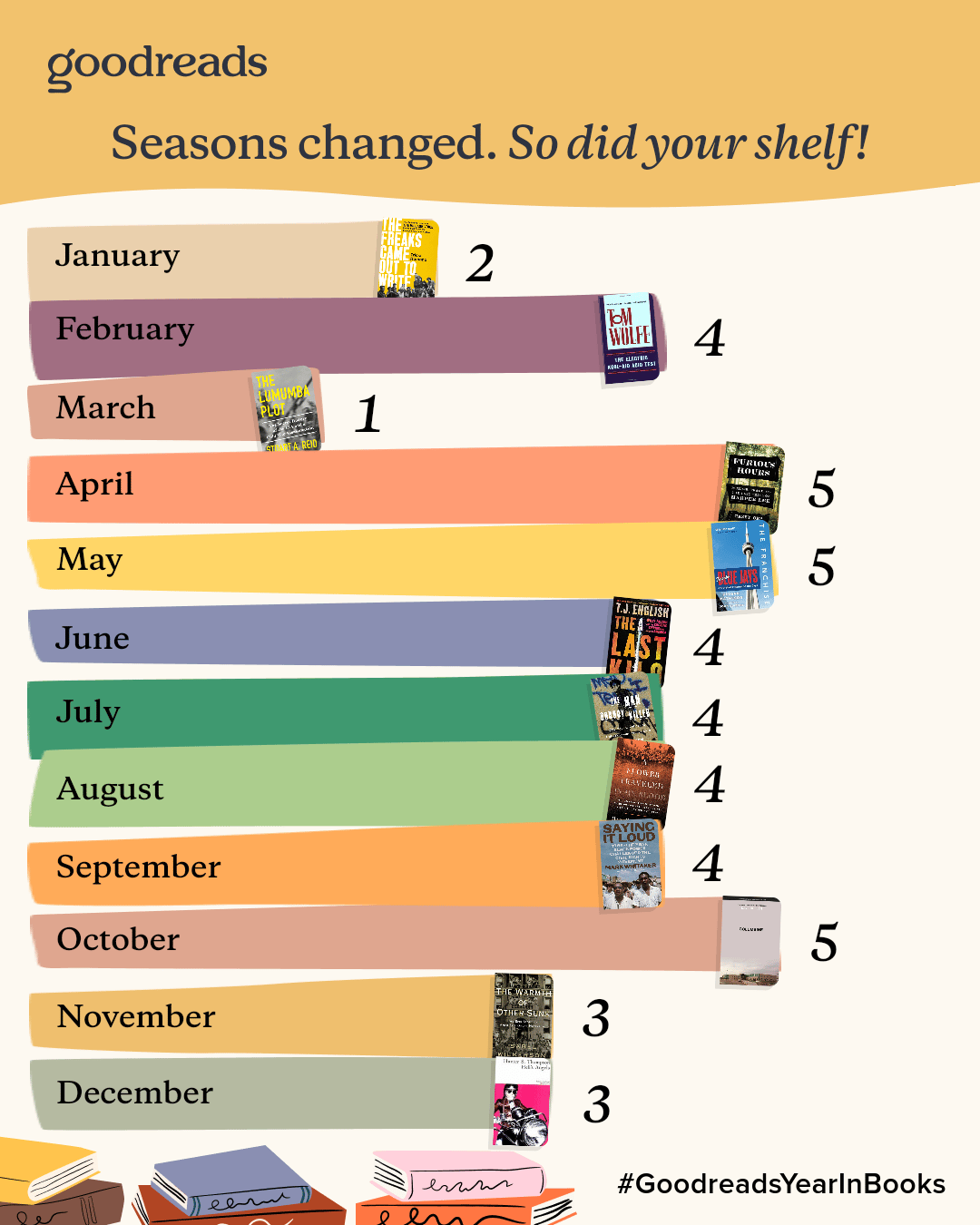
I finished another book in December after this, so that should be four. Also in March was when I was reading “The Power Broker” so hence only one book finished that month!
The Last Kilo - T.J. English
Tony Montana was not a real person, but he was loosely based on Willy Falcon, the main subject of English’s terrific look at cocaine trafficking in Miami in the ‘70s and ‘80s, and Falcon’s run from the law in the ‘90s. After fleeing Cuba as a child, Willy Falcon grew up in Miami with hopes of the American dream, which he and his brother Gustavo turned on its head when they became the largest cocaine importers into the United States. “The Last Kilo” pulls back the myths of the cocaine era, shows the reality that “Scarface” put a glossy cover on, and leaves bare the consequences of a life of crime.
The Warmth of Other Suns - Isabel Wilkerson
I was in awe with this book, its research, and the stories it weaves together. Researched over fifteen (!) years, Wilkerson tracks the story of the Great Migration of Black people in the US through the personal stories of three individuals. Heart-wrenching, beautifully written, this book also has my favourite book title probably ever, just so evocative and powerful. A must read for everyone, really.

The Electric Kool-Aid Acid Test - Tom Wolfe
Another thing I’ve tried to do this year is read some classics of narrative nonfiction (I also read “Hells Angels” by Hunter S. Thompson and “Armies of the Night” by Norman Mailer). While this wasn’t my first Tom Wolfe book (I read “Pump House Gang” a few years ago) I felt like I really understood his writing style in the context of this book. What was fascinating to me was how much of the stereotype image of a 1960s hippie really came from Ken Kesey and the Merry Pranksters and their invented slang, clothing style, and mannerisms.
The Man Nobody Killed - Elon Green
This is a book that came out in early 2025 and I feel like it is deserving of more attention. Covering the early 1980s murder of up and coming Black artist Michael Stewart by New York City police, this book is a true crime narrative set in the ‘80s New York art world. Side characters include Madonna, Jean-Michel Basquiat and Keith Haring, all of whom were contemporaries of Stewart before his murder. This book is a story of police brutality that helps bring to light a largely forgotten story in a pivotal era. I’d love to see this book appreciated by more of the art world types here in Winnipeg for its prescience.

Perversion of Justice - Julie K. Brown
I have to give a mention to Julie K. Brown and her amazing book about the crimes of Jeffrey Epstein. Although it came out in 2021, this book of course is still very relevant to the news of today, and I think anybody who has been following the Epstein files story even in the slightest this year should take the time to read this book and learn the stories of his victims, and of how his power and wealth allowed him to avoid true justice.
Dead Wake - Erik Larson
About the sinking of the Lusitania during World War I, this story I feel has largely been forgotten and overshadowed by the story of the Titanic, but as I was reading “Dead Wake” I couldn’t help but think how similar the stories are, and if perhaps James Cameron had chose to make “The Lusitania” instead of “Titanic” how those might be reversed. Larson’s telling of this story is very compelling, switching back and forth between the German submarine that sunk the ship and the stories of the passengers on board.

The Rest of the List:
Jungle of Stone - William Carlsen
Hell’s Angels - Hunter S. Thompson
In the Kingdom of Ice - Hampton Sides
Where the Bodies Were Buried - T.J. English
Bolivar - Marie Arana (Honourable Mention)
Deliver Me From Nowhere - Warren Zanes
Casino - Nicholas Pileggi
Black Hawk Down - Mark Bowden
The Devil Reached Toward the Sky - Garrett Graff (Honourable Mention)
Saying It Loud - Mark Whitaker
Missing Like Teeth - Sheldon Birnie (re-read)
Say Nothing - Patrick Radden Keefe (re-read)
Zodiac - Robert Graysmith
When the Clock Broke - John Ganz
The Lost City of the Monkey God - Douglas Preston
I Heard You Paint Houses - Charles Brandt
When the Sea Came Alive - Garrett Graff
The Armies of the Night - Norman Mailer
The Gangs of New York - Herbert Asbury
Serpico - Peter Maas
The Franchise - Keegan Matheson
Lord of the Flies - William Golding
Typhoid Mary - Anthony Bourdain
The Eagle and the Hart - Helen Castor
The Rape of Nanking - Iris Chang
Dilla Time - Dan Charnas
Furious Hours - Casey Cep (Honourable Mention)
Unscripted - James B. Stewart & Rachel Abrams
Astor - Anderson Cooper & Katherine Howe
The Lumumba Plot - Stuart A. Reid (Honourable Mention)
Words & Music - John Einarson
Catching the Big Fish - David Lynch
The Freaks Came Out To Write - Tricia Romano
Lucky Loser - Russ Buettner & Susanne Craig
Thanks for reading my newsletter, it means a lot to me. Hope you’ve enjoyed some of the content I put out in 2025, I’ve got some cool stuff I plan to write about this next year so stay tuned for that. If you’ve read any of the above books and would like to discuss, feel free to get in touch, I love chatting about books.
Happy New Year!
-Respect,
NW
“My journalistic range is a catalyst for change” - Black Thought